Helmets on babies aren’t just for looks (though they’re the cutest!).
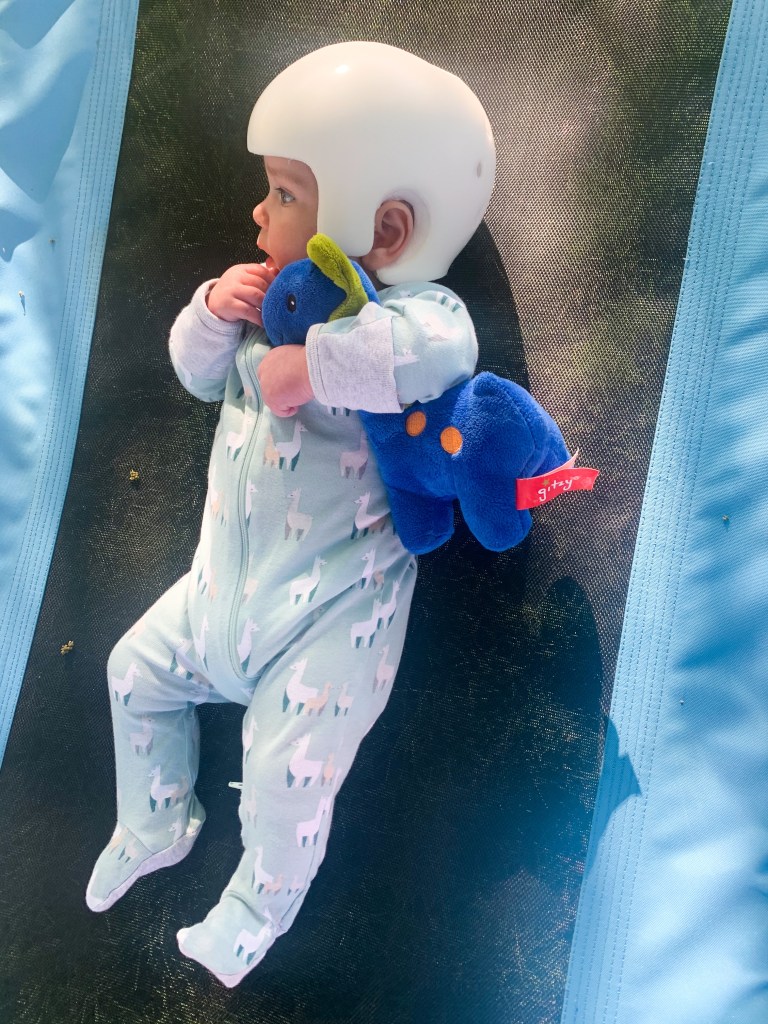
Here’s Bean’s story:
We noticed around 3 months that his head had a bit of a lump on the back right side. We tried to keep him off his head, strapping him onto ourselves or holding him most of the time. We mentioned it to his pediatrician, and that’s when the ball got rolling.
She diagnosed him with plagiocephaly, which is a fancy word that just means a flat head. She also explained that it wasn’t my fault (though, it’s hard to accept!).
We then received a referral to a pediatric physical therapist. She checked him out, and decided that his plagiocephaly wasn’t a result of tightness in his neck. He just prefers to turn his head to the left! Because of this preference, the left side of his head was flat.
Since there was no tightness, stretching in physical therapy wouldn’t make a difference. We had activities she gave us to help him practice turning right, but we couldn’t do much. We waited a few months, and then his doctor decided it was time to get him in to an orthotics clinic. His therapist gave us a list of clinics to choose from, so it came down to calling insurance to see which clinics they cover. A few important things to remember before choosing a clinic:

I will ALWAYS suggest to work with a provider, communicate with your insurance, and ask ALL the questions. This can save you from lots of financial stress or confusion in the future.
We went in for a consult after deciding on a clinic based on recommendations from the PT and insurance, and sat down to discuss options. He measured Bean’s head, and the most important measurements were the diagonal distance (left forehead to right back of head, and vice versa). The difference between these two numbers is what was used to decide that Bean was eligible for a helmet. After that, he did some scans and we were on our way.
About two weeks later, we went back and the helmet was ready. He put it on Bean, and adjusted some parts that didn’t fit quite right. Once he was done, he brought it back and it fit perfectly.
I had assumed that he would wear it right then, but I was given a schedule to follow to wean him into wearing it. We started with one hour on, one hour off, easing into naps and eventually bedtime. After a week, he was wearing it 23 hours on, 1 hour off.
I know it seems so daunting. I was so nervous at first!, but now I barely even notice it. Bean doesn’t mind wearing it, which I’m surprised about since it’s been 90 degrees or hotter everyday and he gets sweaty. In the hour that he has it off, I usually take a cold baby wipe and wipe his head to cool him off. To be silly, we let him keep the wipe on his head and he loves it!
If you’re worried about the money aspect, take control by calling insurance and saving up a little. If it’s an option, get a flex spending or at least start setting aside some funds to cover the cost. With our insurance, our portion was under $1,000 and the no insurance/ cash payment amount would have been $2,000. It entirely depends on the clinic. You’ll get an estimate in the first appointment, so just (as always) ask questions.
The best part of the helmet: decorating! We got a white one so we can decorate it soon, but they also have different colors or patterns to choose from. Have fun, and make the best of the situation.
I haven’t received criticism for choosing the helmet, but I have had people tell me their child’s head was flat but they were fine without it, and I’ve heard of people who weren’t supportive. If you and your pediatrician believe it’s the right choice, don’t let others bully you into doubting yourself! I will never regret taking care of this early while it’s still an option so my son can grow up without an uneven forehead, a misshapen back of his head, or having his ears get even more misaligned.
It’s been an interesting experience, but Bean sure looks ADORABLE in his helmet and I know it was the right choice.
Got questions? Reach out to me! I’d love to chat.
Love,

 The Perry People